
Have you ever heard of an antelope that lives in both water and land? If you are wondering if it exists—yes, it does! It is called a Sitatunga. This animal is deemed to be the most aquatic antelope.
Read further to know more about the Sitatunga!
What is a Sitatunga?
The Sitatunga, or also known as Marshbuck, is a species of antelope that is usually found in the swamps of central Africa. Deemed as the most aquatic antelope, they are relatively common in central Congo, southern Sudan, Ghana, Botswana, Tanzania, Gabon, Central African Republic, Kenya, and Uganda. Its binomial name is Tragelaphus spekii.
The Sitatunga was first described in 1863 by British Indian Army officer John Hanning Speke, who first saw the animal at Little Windermere, presently Lake Lwelo in Kagera, Tanzania. He initially named the animal “nzoé” or “water boc,” due to its striking similarities with a Waterbuck.
This species was categorized under the genus Tragelaphus and family Bovidae, which also includes Nyala and Kudu.
Its eight levels of scientific classification are as follows:
Kingdom: Animalia
Phylum: Chordata
Class: Mammalia
Order: Artiodactyla
Family: Bovidae
Subfamily: Bovinae
Genus: Tragelaphus
Species: T. spekii
Physical characteristics of a Sitatunga
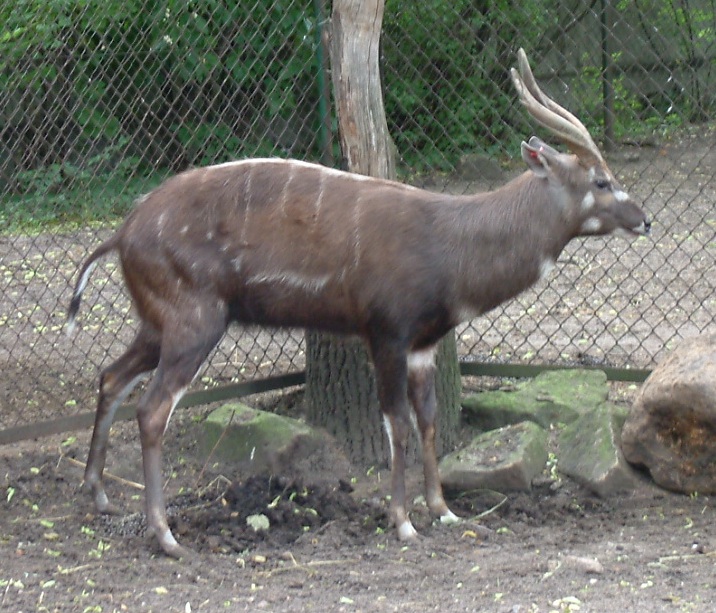
The Sitatunga is a sexually dimorphic animal. This means that male and female Sitatungas share different physical characteristics that extend beyond the differences in sex organs. Male Sitatungas are larger than females. A male Sitatunga’s head-and-body length stands between 136-177 cm and weighs between 76-119. Meanwhile, a female Sitatunga stands between 104-146 cm and weighs between 24-57 kg.
Coat colors vary between males and females, too. Males usually have chocolate-brown or gray-brown coats, while females have brown to bright chestnut. Both genders have white markings all over their bodies.
As a male Sitatunga age, its coat shifts from chocolate-brown to dark-brown or grey. Over time, it develops a brown mane and a dorsal stripe that’s white in color.
Males are the only ones who possess ivory-tipped horns. Both genders have strong, elongated legs that work so well in a swampy habitat. Their shaggy, water-repellent coats are mildly affected by the muddy and slimy characteristics of a marsh. Their banana-shaped hooves are 16 cm long on average. Their pointed toes make no noise when they walk in the water, making them inconspicuous mammals in their habitats.
Sitatunga’s distribution and habitat
Since they are amphibious (an animal that lives in both land and water), Sitatungas prefer living and thriving at the southern savanna’s wetter parts. A wetland can support an average of 55 individuals per square km. Most Sitatungas also take refuge in the southwestern region of the African rainforest.
Numbers of Sitatunga were also sighted in swampy habitats and mangrove swamps. They are most common in central, southern, and eastern Africa. They are facing near extinction in the Republic of Niger and in Togo, where human activities have threatened their habitats.
A Sitatunga’s Behavior
This kind of antelope is nonterritorial. It shifts from one place to another to seek food and shelter. A Sitatunga usually prefers living alone, particularly males. Two or three female Sitatungas with their calves, often with one male, is probably the largest herd that can be seen.
Sitatungas do not only hunt for food in the swamp. They often come ashore when the sun’s down to nearby drylands such as woodlands to browse herbs and foliage.
Common predators such as African wild dogs, spotted hyenas, and lions can easily catch a Sitatunga, except when it’s on water. They are adept at running in the water, but they are likely to be clumsy when they run on dry land.
Other interesting facts that you should know about Sitatunga
Male Sitatungas often bark at night as an alarm or to announce its current location. Meanwhile, female Sitatungas have high-pitched bark. Once a male Sitatunga sees a female, it may utter a repressed roar.
Breeding season occurs throughout the year, but most female Sitatungas give birth during the dry season, after a seven-and-a-half-month gestation period. Females reach sexual maturity by the age of one, while males achieve theirs at 1.5 years old.
Since its population in the African continent is at a stable rise, the International Union for Conservation of Nature (IUCN) Red List classified this species as Least Concern.
In Senegal, Sitatungas are widely hunted for meat, which made them very rare in the country. Some people find value on their skin, too.
WILDLIFE PARKS AND RESERVES WHERE THIS SPECIES IS FOUND: