
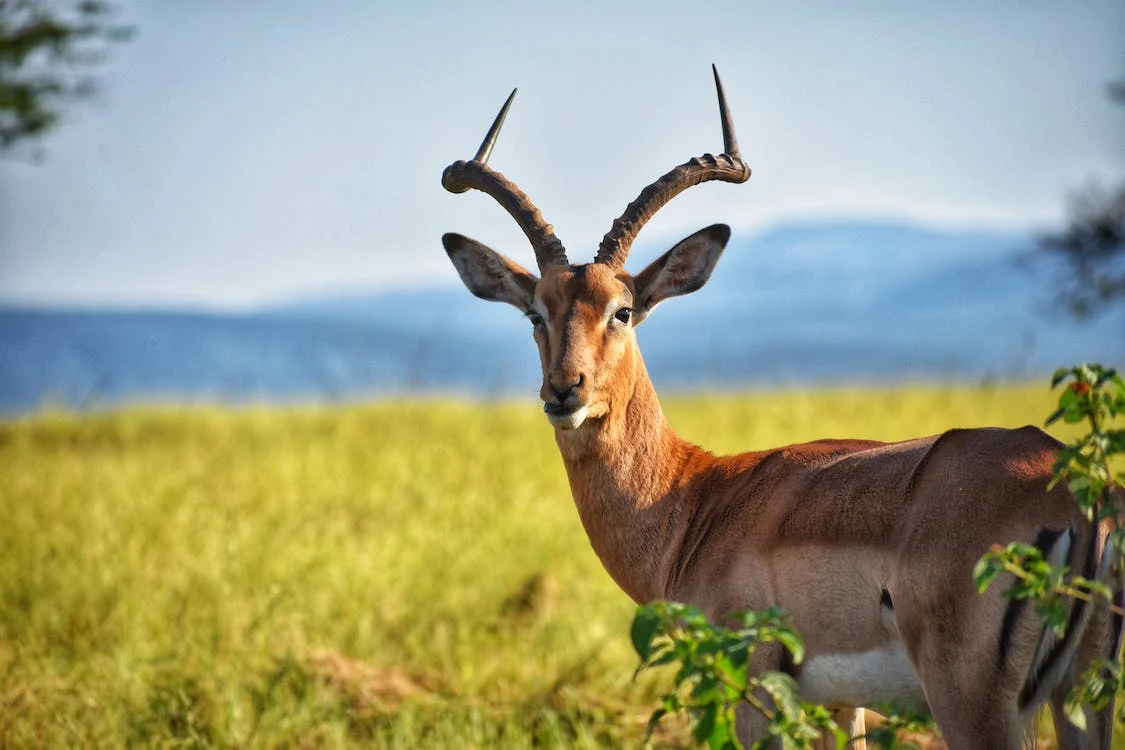
One of the largest antelopes in the world, the Roan Antelope is a native to central and southern Africa. It is characterized by its reddish-brown color and its robust built.
Read further to know more about the Roan Antelope!
What is the Roan Antelope?
The Roan Antelope, or also known as Hippotragus eqinus, is a species of antelope that is endemic to the savannahs of the west and central Africa. Categorized under the Bovidae family and the genus Hippotragus, this animal is one of the largest and most intimidating African antelope.
This antelope looks like its close relative, the Sable Antelope, only that the latter is slightly smaller than the Roan Antelope. Sable Antelopes are darker in color, as compared to Roan Antelope's dark brown coloring.
This species was first described in 1803 by French naturalist Étienne Geoffroy Saint-Hilaire. Since its current population is at a stable rise, the International Union for Conservation of Nature (IUCN) Red List classified this species as "Least Concern."
Its eight levels of scientific classification are as follows:
Kingdom: Animalia
Phylum: Chordata
Class: Mammalia
Order: Artiodactyla
Family: Bovidae
Subfamily: Hippotraginae
Genus: Hippotragus
Species: H. equinus
Physical characteristics of a Roan Antelope
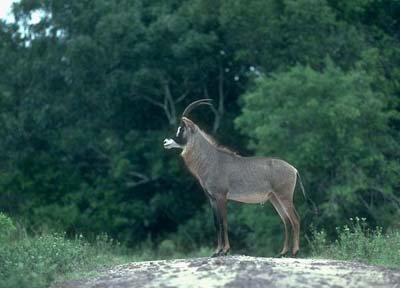
The Roan Antelope has a well-developed built with long, sturdy limbs and thick neck that looks thicker than it usually is because of its mane and beard. Its body is reddish-brown or grayish-brown in color, with hints of red all over the body. Its legs are much darker in color. The Roan Antelope's long, narrow head is black in color, with white patches in front of the eyes and nose. Its long ears have dark brown tips. Its tail consists of long black hairs.
Both male and female Roan Antelopes have horns that protrude at the top of the head and then sweep backward to make scimitar-shaped curves. Female Roan Antelopes usually have shorter horns.
On average, a Roan Antelope measures 75-94 inches. A male Roan Antelope weighs 242-300 kg, while a female Roan Antelope weighs 223-280 kg.
Roan Antelope's distribution and habitat
The geographical range of Roan Antelopes extends across grassland savannas, tropical grasslands, subtropical grasslands, and dense forests. Since they are grazers and browsers, they prefer wooded and grassland savannahs, but they frequent in montane grasslands and floodplains.
This type of species can be found in central and southern regions of the African continent.
How Roan Antelopes reproduce and multiply in number
These animals are polygynous. Male Roan Antelopes fight among themselves using their horns for the dominant position in a herd of female Roan Antelopes. Usually, fights can be savagely violent, but these rarely result in death.
On the other hand, a female Roan Antelope can reproduce every 10 to 10.5 months. It achieves sexual maturity once it reaches 32 to 34 months of age. After a gestation period of 260 to 281 days, a female Roan Antelope gives birth to a single calf. Two weeks prior to giving birth, the female Roan Antelope would leave the herd. After giving birth, it will leave its newborn in hiding and will return to its herd. During the nighttime, it will visit its calf and spend the rest of the night with it. The Roan Antelope's calf will remain hidden for four to five weeks from birth.
The behavior of a Roan Antelope
Like most antelopes, the Roan Antelopes are very territorial and sociable. Roan Antelopes prefer to hunt and travel during the colder periods of the day. They only travel in short distances when grazing and browsing, but they can run at the speed of 57km/hr.
One herd usually consists of six to fifteen Roan Antelopes and can grow as many as 35 individuals. These herds have a strict hierarchy—it is typically composed of one dominant male Roan Antelope, female Roan Antelopes, and their calves. A hierarchy among female individuals also exists. A dominant female leader takes the lead of all the females in the herd.
Bachelor males are often evicted from the herd when they reach the age of three. These expelled males form their own herd that is usually composed of 3-5 individuals. If the herds become too massive, some are forced to leave and form herds of their own.
Fun facts about Roan Antelopes
Back in the day, locals and tourists hunt Roan Antelopes for sport and meat. Today, hunting for Roan Antelopes is deemed illegal.
Today, several Roan Antelopes are in wildlife and safari parks to attract tourists.
They play an essential role in the ecosystem too. Roan Antelopes serve as vital prey for their common predators, including Lions, Spotted Hyenas, Nile Crocodiles, and African Wild Dogs.
WILDLIFE PARKS AND RESERVES WHERE THIS SPECIES IS FOUND: