
It has large, round eyes, big ears, and it comes in a cute size—a Lesser Bushbaby is a native to the southern part of Africa. It is considered as one of the most common primates that roam around Africa. They are strikingly adorable and generally harmless. In fact, they are often kept as pets by Africans.
Read further to know more about the Lesser Bushbaby.
What is a Lesser Bushbaby?
This adorable animal is known for many names: Senegal Bushbaby, Senegal Galago, Lesser Galago, or its binomial name, Galago senegalensis. They are tiny primates who are most active during nighttime.
There is a lot to learn about the fascinating, agile mammal called the Large Grey Mongoose. They may appear intimidating and reptilian, but they can sometimes be of help to humankind because of its ability to get rid of pests.
Read on to know more about the Large Grey Mongoose.
What is the Large Grey Mongoose?
The Large Grey Mongoose is known for several names such as Egyptian Mongoose, Ichneumon, and its binomial name Herpestes Ichneumon. They are dominant in the Iberian Peninsula, or the southwest corner of Europe, tropical and subtropical lands, savannas, coastal zones in the Mediterranean Sea, and shrublands in Africa. Due to the rampant prevalence of their population, the IUCN Red List of Threatened Species listed the Mongoose Grey species as Least Concern.
Its seven levels of classification are as follows:
Kingdom: Animalia
Phylum: Chordata
Class: Mammalia
Order: Carnivora
Suborder: Feliformia
Family: Herpestidae
Genus: Herpestes
Species: Herpestes Ichneumon
Large Grey Mongoose physical description
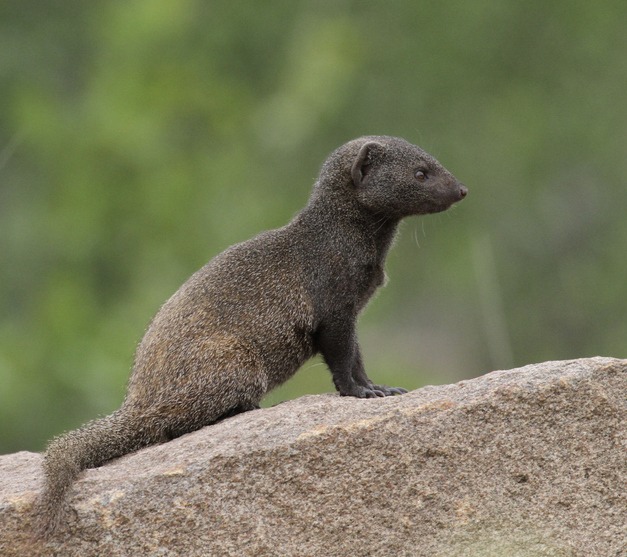
Large Grey Mongoose can weigh from 1.7 to 4kg and can grow from 48 to 60cm long with a 33 to 54cam long black-tipped tail. Its coarse fur is grey or reddish-brown in color dotted with brownish speckles. Some Large Grey Mongooses, however, possess yellowish speckles.
A narrow, naked strip of skin surrounds its eyes. Its slender, long, and low-slung form makes it look like a reptile when seen from a distance. Its face is long and coupled with rounded ears. The Large Grey Mongoose also has 35-40 teeth that are good enough to sheer flesh. Its short legs are naked until the heels, and it possesses sharp, long, and curved foreclaws that make them particularly exceptional at digging the ground for prey.
Where can they be spotted?
Large Grey Mongooses are ground inhabitants who favor living in places with trees and water. However, there are some of its kind that prefer staying in vegetated canal banks and cultivated fields. They take shelter in hollow logs, burrows, ground holes, and rock crevices.
Sightings of the Large Grey Mongooses occurs in the following areas:
Iberian Peninsula - where they live in maquis shrublands
North Africa - along the coast from Western Sahara to Tunisia and from the northern part of Egypt to the Sinai Peninsula
Portugal - northern and southern parts of the Douro River
Spain - in the central plateau, Andalucía to the Strait of Gibraltar (strait that connects the Atlantic Ocean to the Mediterranean Sea)
Other countries also include Sudan, Syria, Turkey, Ethiopia, Tanzania, and the Republic of Congo, among others.
Large Grey Mongooses are dominantly terrestrial, but they are also excellent swimmers. They swim in ponds, dam banks, and shallow waters like Water Mongooses do.
Interesting facts you should know about the Large Grey Mongoose
Several scientists claim that the members of this species have active social lives, but there is only limited evidence to support this claim. This claim is opposite to a two-year Egyptian study, which posits that Large Grey Mongooses only makes an average group size of one to seven mongooses. Adult Large Grey Mongooses were seen to be living in solidarity or pairs throughout the year.
Male and female Large Grey Mongooses achieve sexual maturity when they reach two years of age. In February and June, courtship and mating occur, and an average of two to three pups are born after 11 weeks of gestation. The pups are born hairless and open their eyes after a week of birth.
Researchers also described this species as "opportunistic, omnivorous feeders" that feeds on a wide range of prey such as small mammals, birds, amphibians, reptiles, fish, crabs, arachnids, fungi, rodents, and other plants. Its method of hunting insects is through sniffing the ground. Once they found the prey, they snatch it up or dig it out before eating it.
They are agile, playful, and tend to become extremely vicious. Humans admire them for their sheer capability of catching creatures, including mice, rats, and snakes, that humans consider as pests.
However, not all of their skills are valuable and helpful to humans and other species. Another skill they possess is their ability to kill harmless birds, mammals, and other wildlife that lead to the extinction of some species. Chicken farmers also deem Large Grey Mongoose as a serious pest.
WILDLIFE PARKS AND RESERVES WHERE THIS SPECIES IS FOUND: