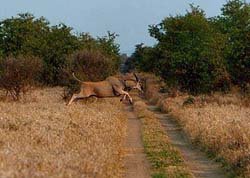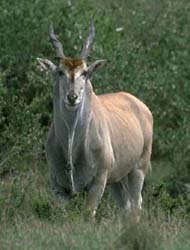
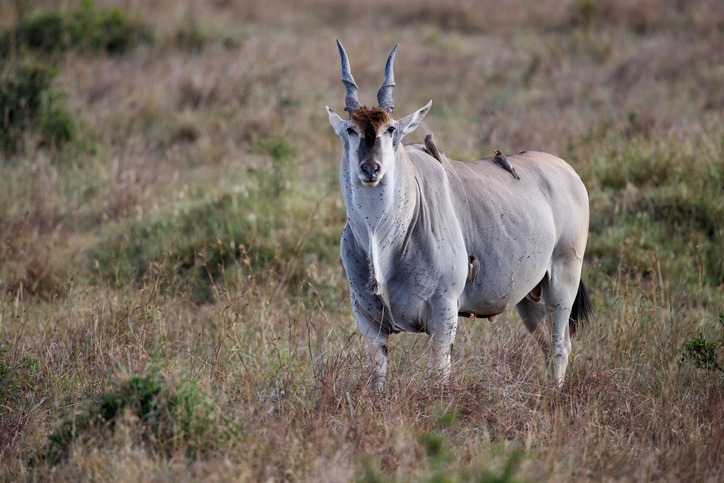
It is the second-largest antelope in the world, with a cow-like appearance. Despite its vast size, it has the power to trot at a rapid pace and extended period, and jump to 4 feet or 1.5 meters, even at a stop. A loud, clicking, conspicuous sound can be heard from its knees as it walks or trots. Both sexes have horns which spiral closely, but females have relatively thinner but longer horns. Females also sport a tawny or fawn-colored coat, while grayish to bluish-gray for the males. Mainly herbivorous, feeding on leaves and grasses, and occurring in herds of up to 500 members, but generally shy, timid, and are not territorial.
Read further to know more about the Common Eland.
What is a Common Eland?
Common Eland(Taurotragus oryx), also called the Eland Antelope or the Southern Eland, is the second-largest antelope extant today, next to the Giant Eland (Taurotragus derbianus). It is a species belonging to the family Bovidae, occurring in East and Southern Africa and preferring savannas and plains as their habitat, while avoiding dense forests. However, they are also domesticated and are used by humans for their high-quality meat, leather, and rich, nutritious milk.
Its seven levels of classification are as follows:
Kingdom: Animalia
Phylum: Chordata
Class: Mammalia
Order: Artiodactyla
Family: Bovidae
Subfamily: Bovinae
Genus: Taurotragus
Species: T. oryx
Common Eland Physical Description
Common Eland is the second-largest African bovid, a family that includes sheep, cattle, antelopes, buffalos, and bison. Females can grow 79 to 110 inches, stand 49-60 at the shoulder, and weigh around 300 to 600 kilograms. Meanwhile, males can grow 94 to 136 inches, stand 59 to 72 inches at the shoulders, and weigh 900 to 1,000 kilograms.
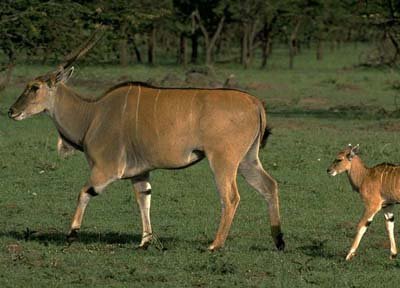
Males have a grayish to bluish-gray coat, while females and juveniles have a tawny or fawn-colored tone. Vertical white bands occur on their flanks while a loose skin, or dewlap, is located on the lower throat, which is believed to help them in dissipating heat. A longer tuft of hair occurs on their forehead.
Both sexes have straight horns that spiral tightly with 1 to 2 turns. Horns appear to be longer and thinner in the females, while shorter and thicker in the males. The use of horns varies depending on sex, with males using them to show ferocity, while females use their horns to protect themselves and their young from predators.
Where can they be spotted?
Common Elands is native to Angola, Botswana, DR Congo, Kenya, Ethiopia, Malawi, Lesotho, Mozambique, Rwanda, Namibia, South Sudan, Swaziland, Uganda, Tanzania, Zimbabwe, Zambia, and South Africa. These large antelopes prefer semi-desert regions, as well as woodlands, coastal plains, savannas, and mountainous areas up to 14,440 feet in elevation, while avoiding densely-wooded forests.
Interesting Facts You Should Know About the Common Eland
Common Elands are herbivores, spending more time browsing than grazing. They feed on areas where bushes or shrubs of the leaves they favor are available, utilizing their horns to bring branches and twigs closer within their reach. Other food items they consume include bulbs, roots, and certain fruits.
These large antelopes consume water gluttonously whenever available, but they can thrive in dry periods without it as long as the food is sufficient. As crepuscular creatures, they can be seen feeding at night, as vegetation collected moisture from the air, giving them more water content.
Common Elands are highly gregarious, occurring in small herds composed of 25-60 individuals, but may aggregate in greater herds during the rainy season, bringing their total number to over 1,000. Mature males aggregate in their own groups, and adult females form their own as well. Juveniles or the youngs clump in nursery herds.
A hierarchy is observed within these herds, which decides a male’s access to the breeding females, or a female’s access to the foraging areas. While they are not territorial, males can be possessive with the breeding females. They are polygynous breeders, which means the domineering males may mate with several females.
Copulation may happen anytime, but generally occurs when they aggregate in abundant plains to forage. The female gives birth a single calf after a gestation period of about 8.5 to 9 months. After a few hours, the calf can run with its mother but is usually hidden in vegetation until it reaches two weeks of age. Common Elands’ milk is nutritious, allowing calves to grow pretty quickly, and soon joining the nursery herd at 4 to 6 months. After two years, they will soon move to the male or female herd.
Habitat loss and hunting are common threats to the Common Elands’ population, though their number appears to be stable. The species is currently listed as Least Concern (LC) under the IUCN Red List of Threatened Species.
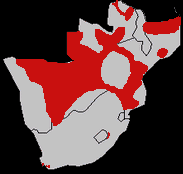
WILDLIFE PARKS AND RESERVES WHERE THIS SPECIES IS FOUND: